
Why Solar Panels Shouldn't Be Installed on Your Roof: The Advantages of Ground-Mounted and Shed-Mounted Solar
Solar energy is one of the best investments homeowners can make toward energy independence. But does that mean solar panels belong on your roof?
For decades, rooftop installations have been promoted as the standard residential solar solution. However, there are compelling reasons to consider a better alternative.
At Off Grid Solar USA, we believe ground-mounted solar arrays and installations on detached sheds offer significant advantages in roof protection, accessibility, maintenance, and long-term reliability.
Here is why keeping solar panels off your roof may be one of the smartest decisions you make for your property.
1. Protect Your Roof from Unnecessary Damage and Water Leaks
Your roof has one primary job: protecting your home from the elements.
Traditional rooftop solar installations typically require mounting brackets attached directly to the roof structure. These attachments create roof penetrations that must be properly flashed and sealed.
Even when professionally installed, these additional attachment points introduce potential maintenance concerns.
Potential problems include:
Water intrusion: Deteriorating or improperly installed flashing can create opportunities for leaks.
Roof deterioration: Weather and aging can affect mounting components and seals.
Additional maintenance: Solar equipment can complicate roof inspections and repairs.
Future expenses: Panels may need to be removed and reinstalled when replacing the roof.
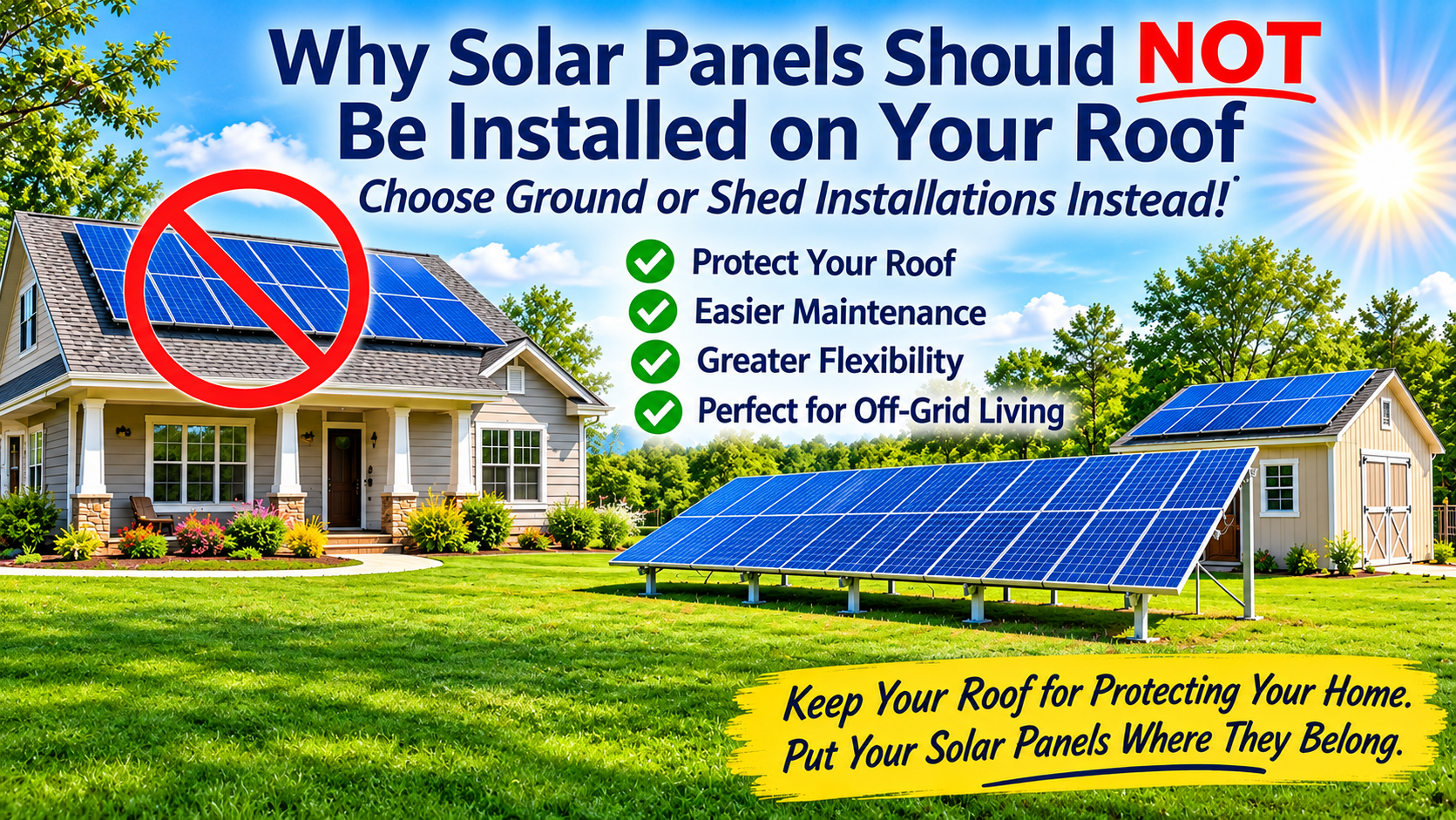
Ground-mounted systems eliminate the need for solar mounting penetrations in your home's roof. Shed-mounted installations offer the same advantage when panels are installed on a detached structure.
Your roof should protect your home, not serve as a mounting platform for your energy system.
2. Simplify Roof Replacement and Future Repairs
Every roof eventually needs replacement. With rooftop solar, this becomes a more complicated and expensive project.
The panels generally need to be disconnected and removed before roofing work begins, then reinstalled and reconnected afterward.
This means additional labor, contractor coordination, and expenses.
With ground-mounted solar, your roof and energy system remain completely independent. You can replace shingles, repair flashing, or make structural improvements without disturbing your solar installation.
The same principle applies to detached shed installations.
3. Easier Maintenance, Cleaning, and Inspections
Solar panels require periodic inspection and occasional cleaning to remove accumulated dust, pollen, leaves, and other debris.
Rooftop installations make these tasks more difficult, often requiring ladders, specialized equipment, and additional safety precautions.
Ground-mounted systems provide convenient access for:
Inspecting panels and mounting hardware.
Cleaning panel surfaces when necessary.
Checking electrical connections and wiring.
Identifying damaged components.
Performing routine maintenance.
For off-grid homeowners, accessibility is particularly important. When your solar system supplies your household electricity, convenient inspection and maintenance become essential advantages.
4. Greater Flexibility in Solar Panel Positioning
One of the biggest limitations of rooftop solar is that homeowners must work with the roof they already have.
Its direction, angle, size, and shape are predetermined. Trees, chimneys, dormers, and other obstructions can further limit solar exposure.
Ground-mounted installations allow the array to be positioned according to the property's available space and sunlight conditions.
This provides greater flexibility to optimize:
Solar orientation and panel tilt.
Seasonal sunlight exposure.
Shading from trees and buildings.
Available land and future expansion.
Access for maintenance.
Rather than adapting your solar system to your roof, you can position the system where it performs best.
5. Detached Sheds Offer an Excellent Solar Installation Alternative
Not every homeowner has sufficient open land for a traditional ground-mounted array. Fortunately, detached sheds, workshops, barns, and garages offer another excellent option.
A suitable outbuilding can provide a separate structure for solar panels while keeping the installation independent of your main residence.
It can also provide space for batteries, inverters, charge controllers, and other electrical equipment when properly designed.
For homeowners with rural properties, workshops, or agricultural buildings, this can be an especially practical solution.
The structure must be suitable for the additional weight and wind loads, and electrical and battery equipment must meet applicable safety requirements.
Your solar system does not have to be attached to your home to power your home.
6. Greater Flexibility for Future Expansion
Your household's energy needs may change over time. You might add an electric vehicle, expand a workshop, install additional appliances, or increase battery storage.
Rooftop systems are limited by available roof space and structural considerations.
Ground-mounted systems offer more flexibility to accommodate additional panels and changing energy requirements, provided sufficient land and electrical capacity are available.
This is particularly valuable for off-grid homeowners who may want to expand their systems as their energy needs evolve.
7. A Better Approach to True Off-Grid Living
There is an important difference between installing solar panels to reduce an electricity bill and designing a property to operate independently of the utility grid.
A true off-grid system must be designed to supply the property's electrical needs without depending on the utility company.
This requires integrating:
Solar panels.
Charge controllers.
Battery storage.
Inverters.
Electrical distribution.
Backup generation, when appropriate.
System monitoring and management.
Ground-mounted and shed-mounted installations allow this infrastructure to be designed as a dedicated energy system, separate from the main residential structure.
This approach offers greater accessibility, flexibility, and convenience for long-term maintenance.
At Off Grid Solar USA, we believe this is a more practical foundation for homeowners pursuing genuine energy independence.
Our philosophy is simple:
Keep your roof for protecting your home. Put your solar panels where they belong.
OFF GRID SOLAR USA